Skip to his life

Melbourne 1912–1970

George Johnston

alias Shane Martin

He grew up in Elsternwick and wrote My Brother Jack about the house. Before that book, on a Greek island, he wrote five crime novels under another name.

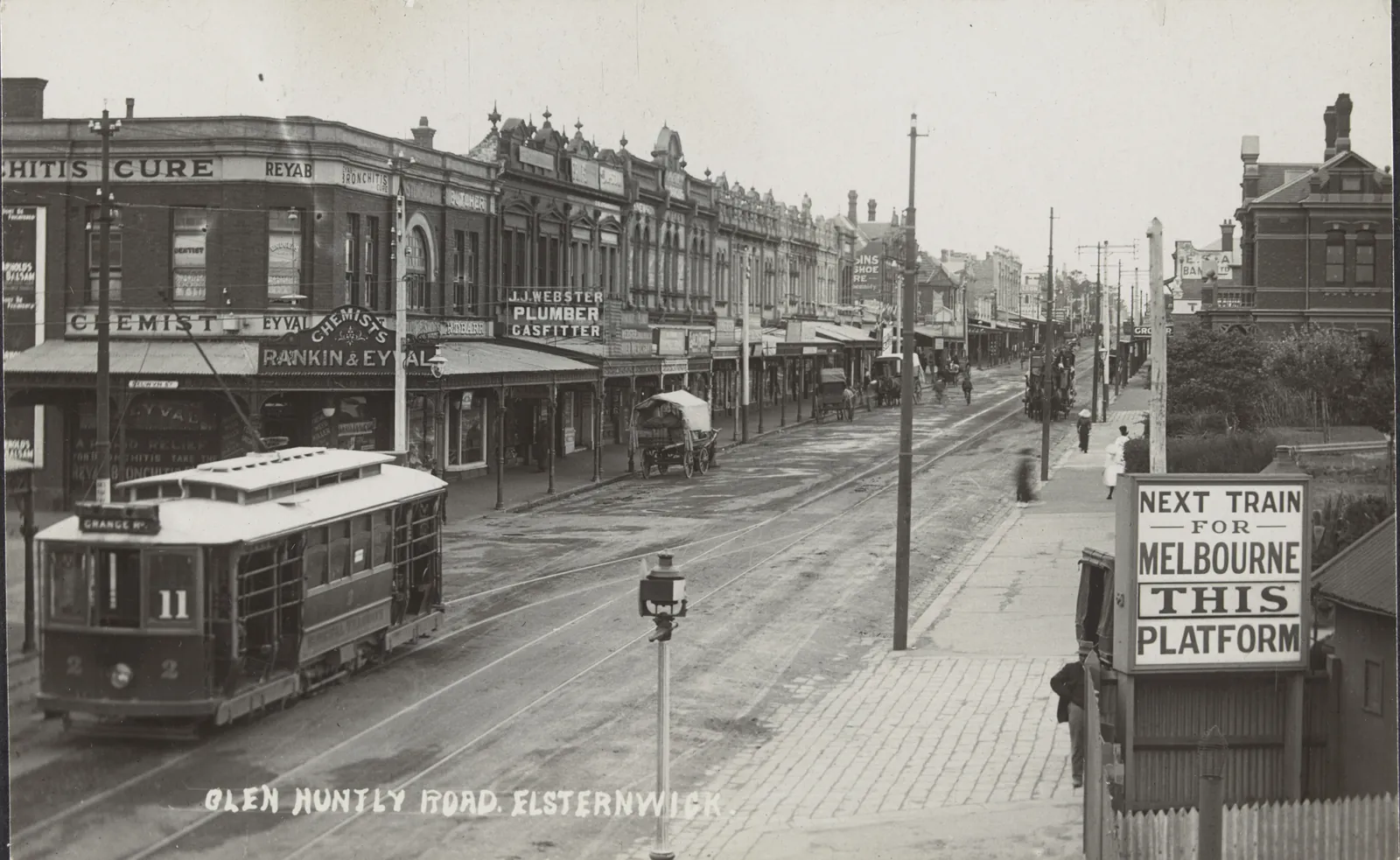
A postcard view along Glen Huntly Road, Elsternwick: an electric tram, number 11, on the left, two-storey shops with verandahs receding along the road, a horse and cart, telegraph poles, and on the right a sign on the station fence, “Next train for Melbourne this platform”.
Glen Huntly Road, Elsternwick, from beside the station, between 1900 and 1930: the suburb of his childhood. His father mended trams. State Library Victoria, H42782/24

Elsternwick1912–1933

11 Buxton Street

George Henry Johnston was born on 20 July 1912, the fourth child of John George Johnston, a tram fitter, and Minnie Riverina Johnston, née Wright, whose father edited the Bendigo Advertiser. In 1915 his father went to the war as a sapper in the 5th Field Company Engineers, and his mother nursed at the military hospital in Caulfield. She brought wounded soldiers home, and one of them stayed long enough to marry George’s elder sister.

Home was 11 Buxton Street, Elsternwick: the address on every family notice The Argus printed from 1928 until his father died there in 1950. The family called the house Lochied. In My Brother Jack it is Avalon, the name “in gilt letters on a blackwood panel”.

He went to Brighton Technical School from 1922, was apprenticed as a lithographer to the art printers Troedel & Cooper, and took classes at the National Gallery school. What he loved was sailing ships. At sixteen The Argus took an article of his on local shipwrecks, and at seventeen he was the secretary of the new Shiplovers’ Society.

The Argus1933–1946

Licence No. 1

In 1933 The Argus took him on as a cadet reporter, on the shipping round. He married Elsie Esme Taylor at St Mary’s, Caulfield, in 1938. In 1941 their daughter Gae was born, and his book on the cruiser HMAS Sydney, Grey Gladiator, sold out on its first day.

On 9 February 1942 he left Melbourne for Port Moresby, appointed, The Argus said next morning, “the first accredited war correspondent” of the Australian Government. His licence was No. 1. Over the next three years he reported from New Guinea, Britain, the United States, India, China, Burma, Tibet and Italy, and on 2 September 1945 he was on board USS Missouri in Tokyo Bay for the surrender of Japan.

He came home that October famous. The paper’s managing director, Errol Knox, called him “golden boy” and made him the first editor of a new weekly, the Australasian Post, which went on sale on 11 April 1946: 64 pages for sixpence.

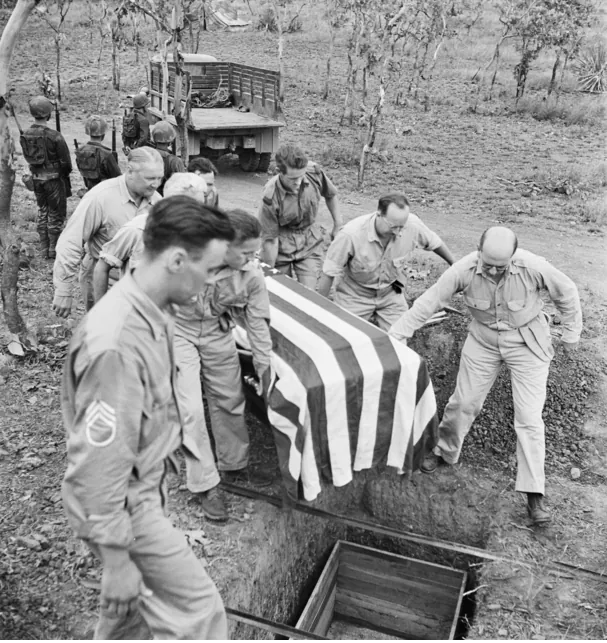
Looking down on an open grave in red earth among thin trees: men in khaki shirts lower a coffin draped in the American flag; an American sergeant stands at the left.
Port Moresby, 29 October 1942: war correspondents carry Byron Darnton of the New York Times, killed when an American bomber attacked his boat. Johnston, of The Argus, was the one Australian pall-bearer. George Silk, Australian War Memorial, 013475
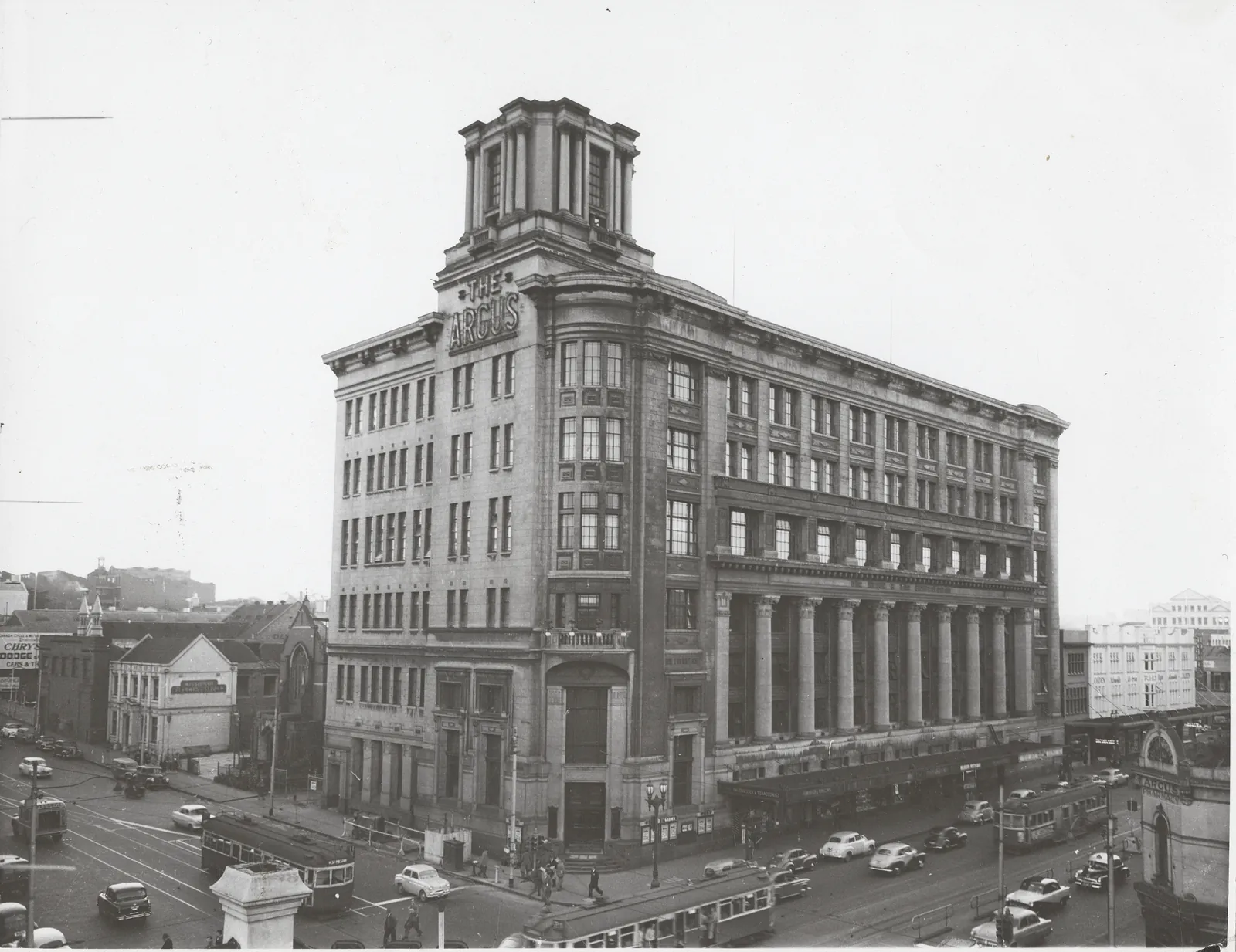
A high view of a pale stone office block on a street corner, seven storeys with a square tower at the corner lettered “The Argus”, a giant colonnade along its long front, trams and cars in the streets below.
The Argus building, Elizabeth and La Trobe Streets, Melbourne, about 1950. He worked here from 1933 to 1946. Herald & Weekly Times, State Library Victoria, H2018.341/1
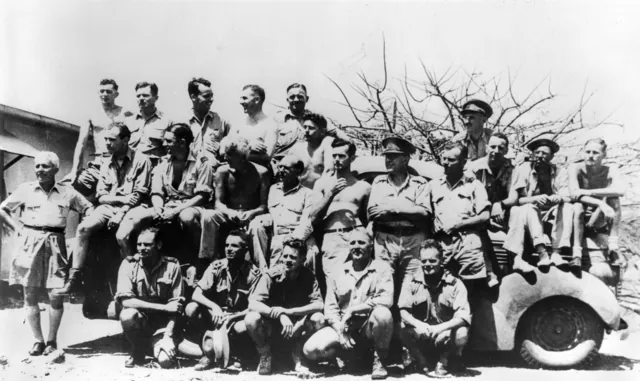
About twenty men in tropical kit posed on and around an open car in hard sun, some standing on it, some sitting on the bonnet, some crouching in front.
The war correspondents at their Four Mile camp, Port Moresby, 1 November 1942. The Memorial’s record names Johnston among them, with Chester Wilmot. Australian War Memorial, 044146
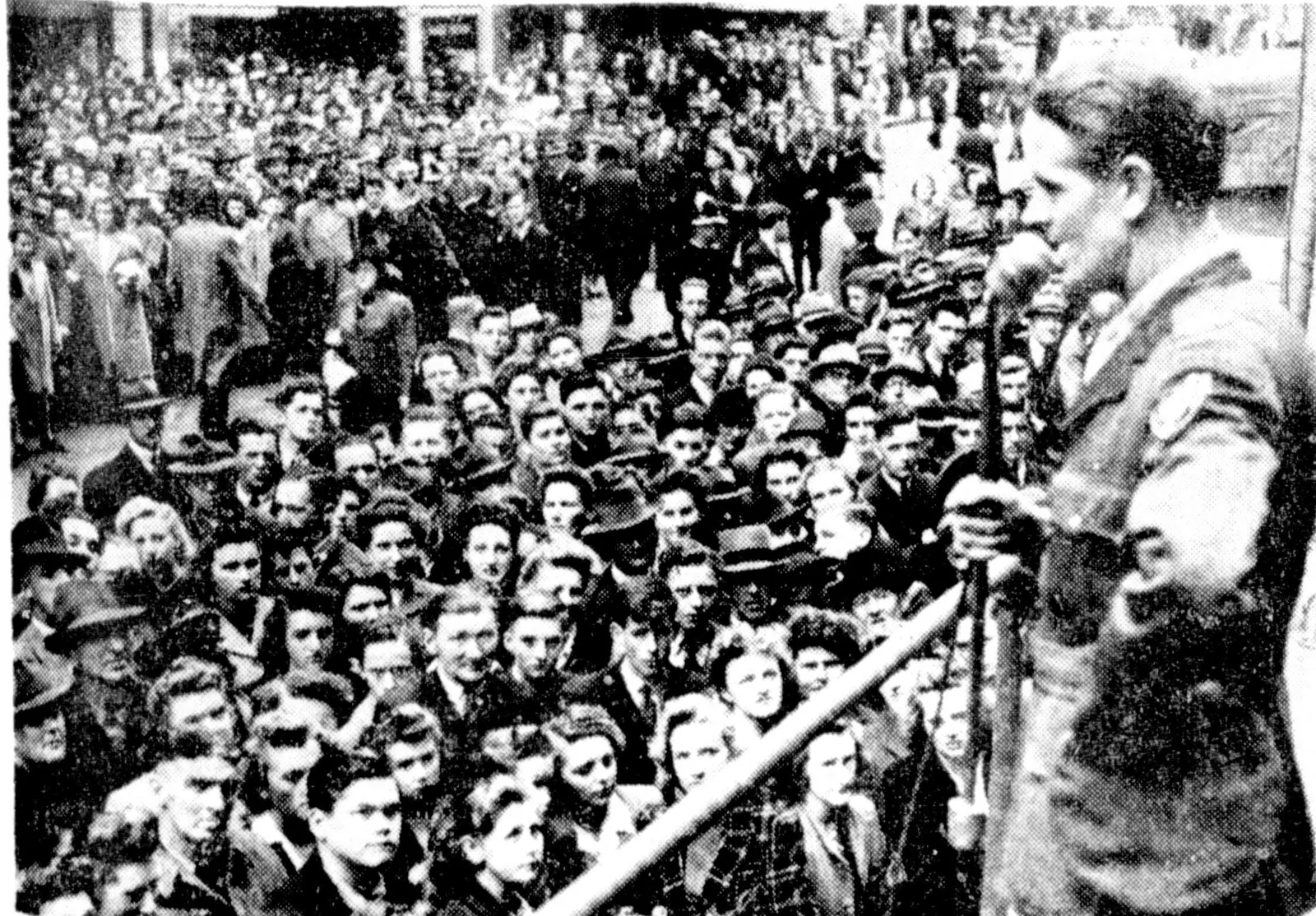
A man in uniform speaks into a microphone from a platform at the right; below him a dense crowd of men and women in hats fills the street, looking up.
Home from the East Asian front, he speaks for the Third Victory Loan in Collins Street, 24 April 1945. The Argus, 25 April 1945, page 9, via Trove, National Library of Australia

Sydney · London1946–1954

Charmian Clift

Charmian Clift, from Kiama, joined The Argus in 1946. Within months they had both left it, together; the accounts differ on which of them was sacked and which resigned. They went to Sydney, and after his divorce they married at the court-house in Manly on 7 August 1947. Their son Martin was born that year and their daughter Shane in 1949.

He wrote features for The Sun and, in 1948, a thriller, Death Takes Small Bites. With Clift he wrote High Valley, a novel of Tibet, which won the Sydney Morning Herald’s £2000 prize for 1948.

In February 1951 they sailed for London in the Orcades. He was to run the London bureau of Associated Newspapers, and he wrote a weekly London Diary for The Sun.

“I was the journalist who supplied the substance … she was the artist who supplied the burnish.”

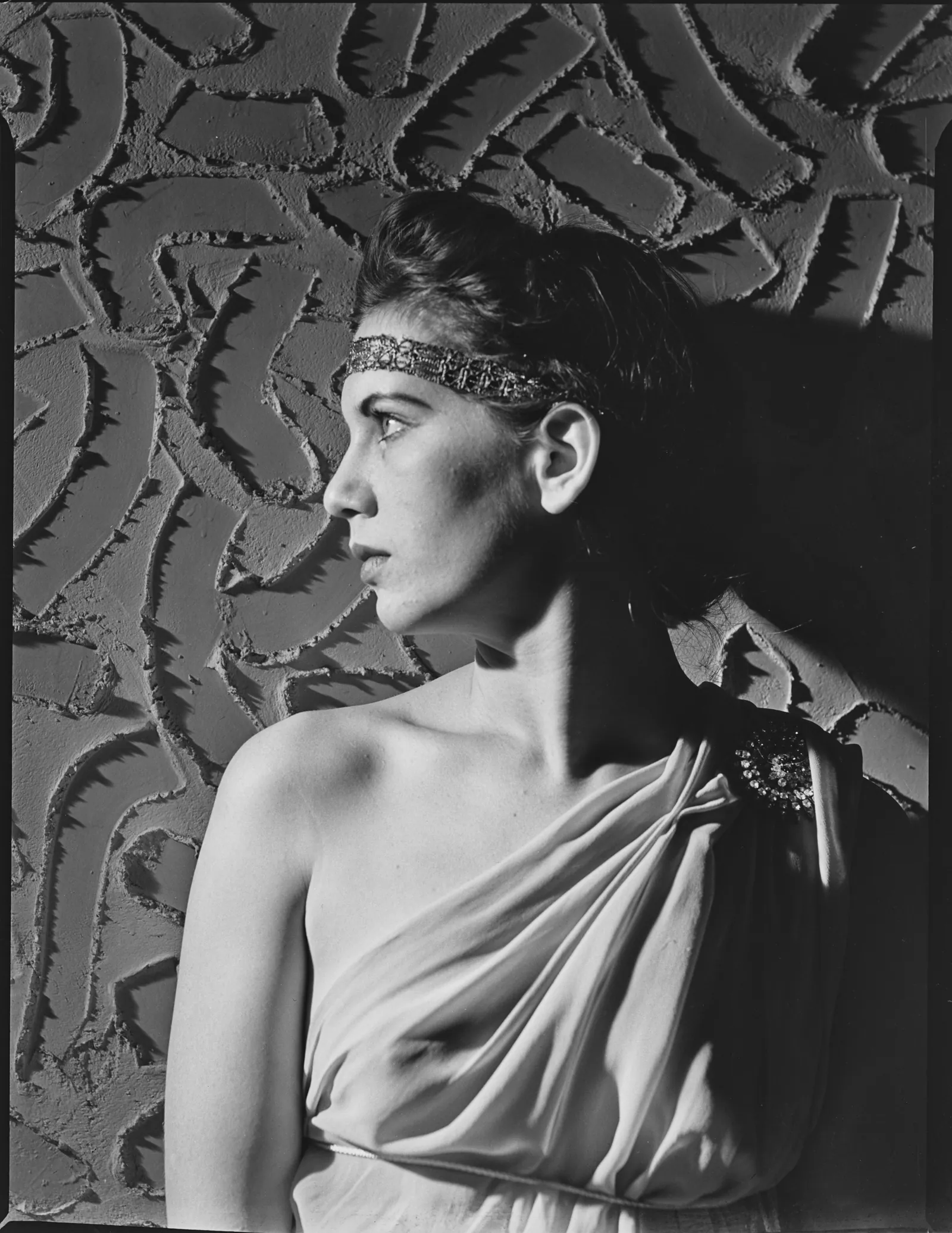
A studio portrait of a young woman in left profile, her dark hair swept up under a jewelled headband, one shoulder bare and the other draped in a pale gown pinned with a brooch, her shadow on a patterned wall.
Charmian Clift at seventeen, photographed for a magazine on 23 June 1941. Animated by AI from the photograph; the movement is ours, not the archive’s. Grimes / ACP Magazines, Mitchell Library, State Library of New South Wales, ON 388/Box 023/Item 068

Kalymnos · Hydra1954–1964

The island

In November 1954 he gave up newspapers and took the family to the Greek islands: first Kalymnos, the sponge divers’ island, and a year later Hydra. There, in March 1956, they bought a house, and in April their third child, Jason, was born.

Hydra had its foreigners. Leonard Cohen gave his first performance as a singer while staying with the Johnstons. Sidney Nolan spent the first winter there, and began his Gallipoli paintings after Johnston lent him the Iliad.

They had come so that he could write, and money was short. Over the ten years, he said later, his writing earned him about £280 a year. In 1959 he found he had tuberculosis.

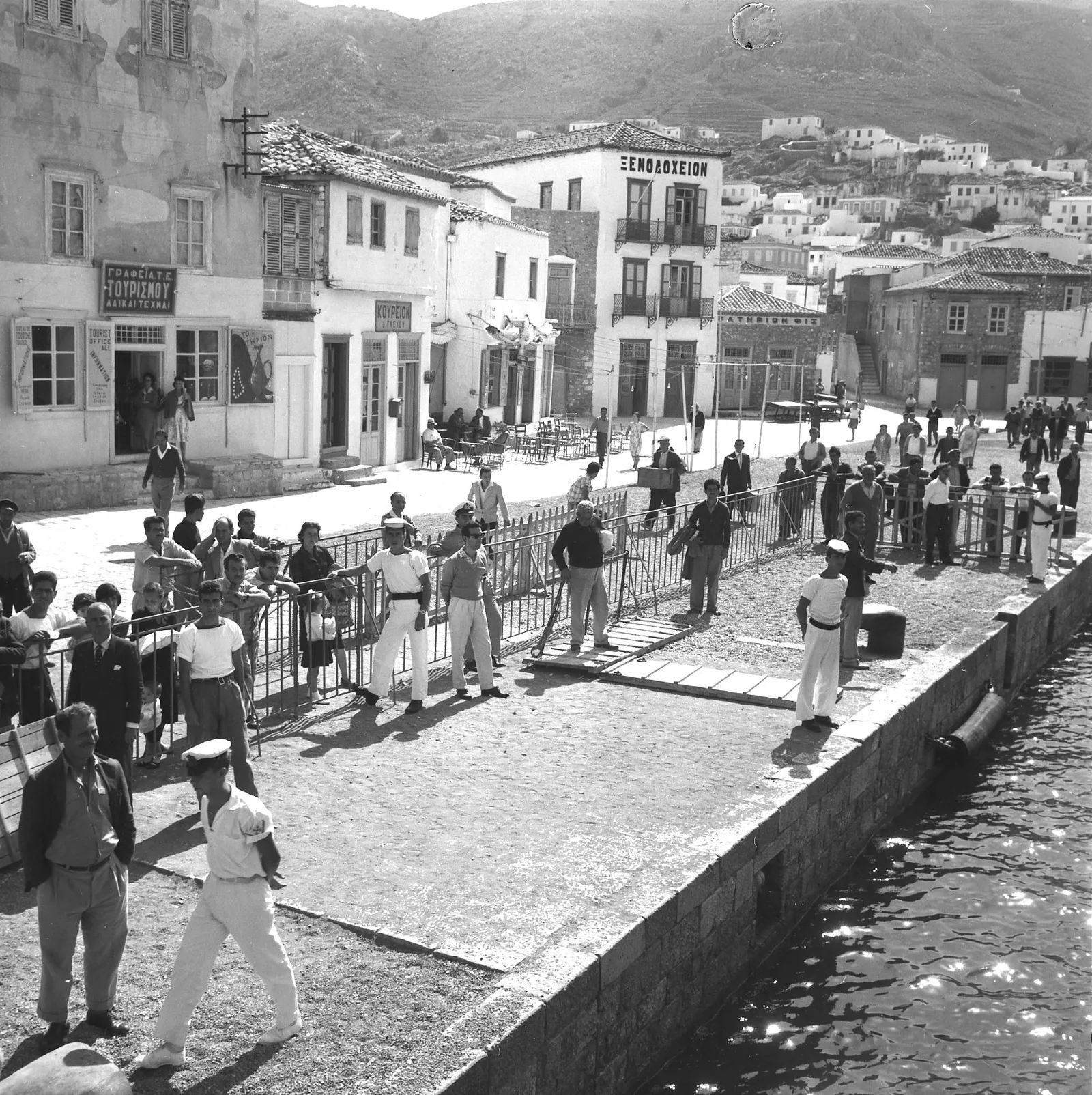
Seen from an arriving boat, a stone quay with a crowd waiting behind an iron barrier, sailors in white among them; behind, a tourist office, a barber’s, café tables, a hotel with iron balconies, and white houses climbing a bare hill.
The quay at Hydra in 1960, meeting the boat from Piraeus. Animated by AI from the photograph; the movement is ours, not the archive’s. Bjørn Glorvigen, Billedbladet NÅ / National Archives of Norway, PA-0797
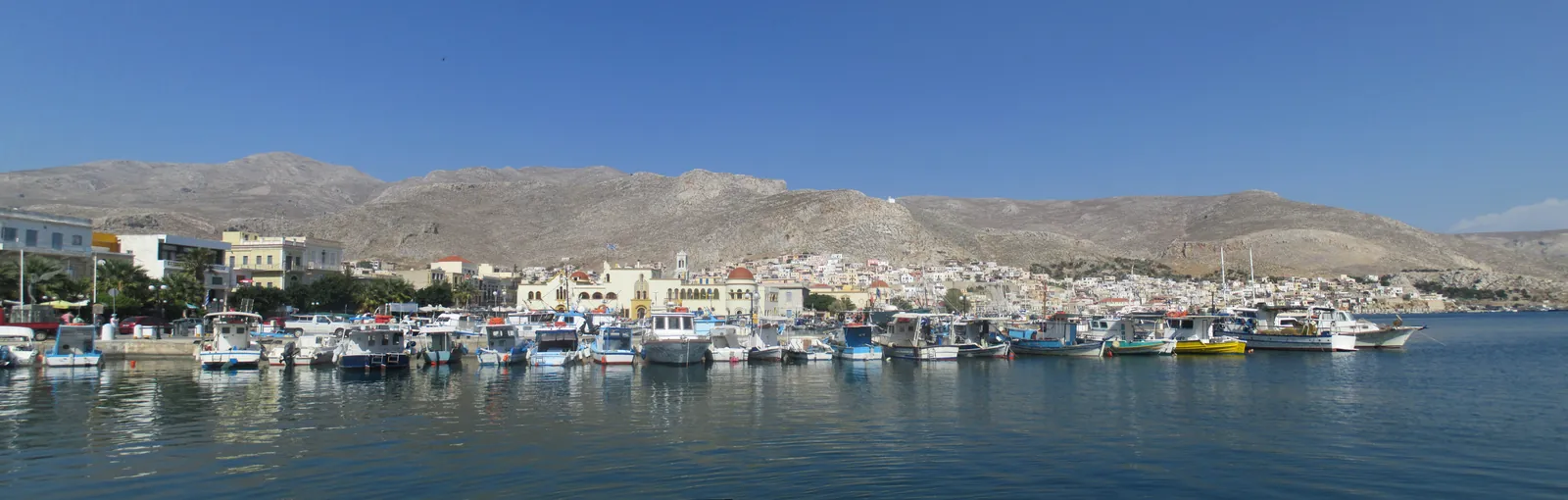
A wide view across a still blue harbour lined with moored fishing boats, the pale houses of a town along the shore and up the slopes, bare grey mountains behind.
Pothia, the harbour of Kalymnos, in 2017. The family lived on the island from November 1954. Tomisti, CC BY-SA 4.0, via Wikimedia Commons

Hydra · Stanton1957–1962

Shane Martin

Shane and Martin were his daughter and his elder son. Under their two names Collins of London published five novels between 1957 and 1962, all with the same detective: Professor Ronald Challis, “the diminutive, sixty-something, American archaeologist and amateur sleuth … who lives in England and does his fieldwork in Greece”.

They were written for money. Clift, as Derham Groves quotes her, said he wrote them “at white-heat at the rate of a couple of months for each one”. In 1957 the American Dollar Book Club took the first, which guaranteed him five thousand dollars; he had three pounds ten shillings in the bank.

None was published in Australia. A Melbourne reviewer of the first guessed that “Shane Martin must be a pseudonym that cloaks either a writer or another Professor”, and in November 1959 a London columnist gave him away: “His pen name, ‘Shane Martin,’ is made up of his children’s Christian names.”

Derham Groves found the five second-hand in 2008, while he was preparing an exhibition on Melbourne crime writers. Four were written on Hydra and the last in England, and he reads them as almost as autobiographical as My Brother Jack. Under each is some of what he found.

“I had to write pot-boilers to live.”

Before Challis

Death Takes Small Bites

By
George H. Johnston
Published
Gollancz, London, 1948; Dodd, Mead, New York; Penguin, 1959; in French as À petit feu, Gallimard, 1951
Set in
The Burma Road, just after the war

Cavendish, an American journalist driving the Burma Road for a magazine story, picks up a red-headed girl whose bus has broken down, and finds the adventure he thought the road did not have: landslides, holed bridges, bandits, murder, and a city with plague. (The Age, 16 October 1948; The Sun, 20 February 1949)

“Its author never claims it to be one and it isn’t. But readable it certainly is.”

From his life

Professor Challis, No. 1

Twelve Girls in the Garden

By
Shane Martin
Published
Collins, London, 1957; William Morrow, New York, May 1957
Set in
Chelsea, the Simplon-Orient Express, Athens and a Greek island

Challis glimpses twelve statues of girls in a London garden and goes looking for their sculptor, Paul Grasset, charming and predatory. Others are looking for him too, among them a model who believes her sister is with him and an investigator for a collector he cheated with a fake. (Kirkus Reviews, 1 May 1957)

“I found it impossible to put this book down once I had become involved in the highly inquisitive researches of Prof. Challis.”

From his life, as Groves found it

  • Its art and art history are what he learned training as a lithographer. Groves, Pursuit
  • Branden Flett, an architecture student in it, lives in the Chelsea house of Johnston’s friend the Australian painter Colin Colahan, and the book is dedicated to Colahan and his wife, Ursula, “for fun”. Groves, Pursuit; Genoni and Dalziell, Southerly, 2017
  • Challis’s London landlord, Mr Valentine, is modelled on his friend the Australian journalist Victor Valentine. Groves, Pursuit

Professor Challis, No. 2

The Saracen Shadow

By
Shane Martin
Published
Collins, London, 1957; not published in America
Set in
Bordeaux and the Dordogne

On holiday in Bordeaux, Challis meets Paul Lemaignon, whose family has carried a curse since the twelfth century, the Saracen Shadow: every other century five of its men die violent deaths, and three have died in this one. (Groves’s synopsis, as Kate Jackson gives it)

Its reviews, Groves found, were fewer and cooler.

From his life, as Groves found it

  • The title comes from one of his old Melbourne haunts, the Saracen’s Head Hotel in Bourke Street. Groves, Pursuit
  • The setting comes from a fortnight’s junket to the Dordogne in 1953, when he was the Sydney Sun’s man in London. Groves, Pursuit
  • His own title was Press the Rue for Wine, from Walter Scott. Collins asked for another. Groves, as Kate Jackson reports

Professor Challis, No. 3

The Man Made of Tin

By
Shane Martin
Published
Collins, London, 1958; not published in America
Set in
Cornwall, in September

Challis is asked to look for a missing woman. A man has gone missing as well, and a romance is assumed; there is a ship run aground, and a closed mine shaft. (Groves’s synopsis, as Kate Jackson gives it)

From his life, as Groves found it

  • The wreck of the Danish freighter Thekla in a storm off Cornwall is the wreck of the German cargo ship Traute Sarnow in 1954, which he had reported for the Sun. Groves, Pursuit
  • Challis’s Cornish landlord is named, “with no deception whatsoever”, after his friend the Cornish journalist Sam Jackett. Groves, Pursuit
  • It is dedicated to Cedric and Pat Flower. Johnston helped start Pat Flower’s career as a crime writer. Groves, as Kate Jackson reports

Professor Challis, No. 4

The Myth is Murder

By
Shane Martin
Published
Collins, London, 1959; as The Third Statue, William Morrow, New York, 1959
Set in
Kalymnos, one week in 1955

A pair of earrings sets Challis looking for Grosteller, a discredited archaeologist some believe still alive, and for the cave where Phidias left a priceless legacy. A crowd of others is after him too, and murder follows them. (Kirkus Reviews, 15 June 1959)

“How the professor goes about the business of unearthing truth is a pure joy.”

Groves calls it arguably the best of the five.

From his life, as Groves found it

Professor Challis, No. 5

A Wake for Mourning

By
Shane Martin
Published
Collins, London, 1962; as Mourners’ Voyage, Doubleday Crime Club, New York, 1963
Set in
Naples, then a schooner on the Mediterranean in July

A party of mourners takes the ashes of the gangster Giuseppe Simione by schooner to a remote island, while another Giuseppe Simione lies on a slab in the Naples morgue. (Doubleday Crime Club advertisement, 1963)

“This time more definitely in the mystery genre than Twelve Girls in the Garden or The Third Statue.”

From his life, as Groves found it

  • He wrote it in England, in a farmhouse at Stanton taken in a six-month house swap, November 1960 to April 1961. Groves, Pursuit; Kate Jackson
  • The schooner took him back to where he started: a sixteen-year-old casual on The Argus, writing about old sailing ships. Groves, Pursuit
  • The absent villain is named after Patricia Simione, a woman with whom he had had an affair. Groves reads it as his answer to Clift’s. Groves, Pursuit

Mosman1962–1970

My Brother Jack

In 1956 Cynthia Nolan wrote that to do better he would have to go “to what he knows — Elwood, Melbourne... Australia”. In 1962, sick on Hydra, he began. My Brother Jack took seven months, with Clift prompting his memory, and the cover was Sidney Nolan’s.

He came home alone early in 1964 to launch it at the Adelaide Festival, and the family followed. It won the Miles Franklin Award for 1964. In 1965 the ABC made it a ten-part serial, scripted by Clift; its designer went to Elsternwick to see the old house, “Avalon”, and found its double in Campsie.

They lived in Raglan Street, Mosman. Clift died there in July 1969. Clean Straw for Nothing, the second book of the three about David Meredith, came out that August and won him a second Miles Franklin. In January 1970 he was made an OBE, and his neighbour Ray Crooke’s portrait of him won the Archibald Prize. He died of tuberculosis on 22 July 1970, aged 58. The third book, A Cartload of Clay, came out unfinished in 1971.

The book2023

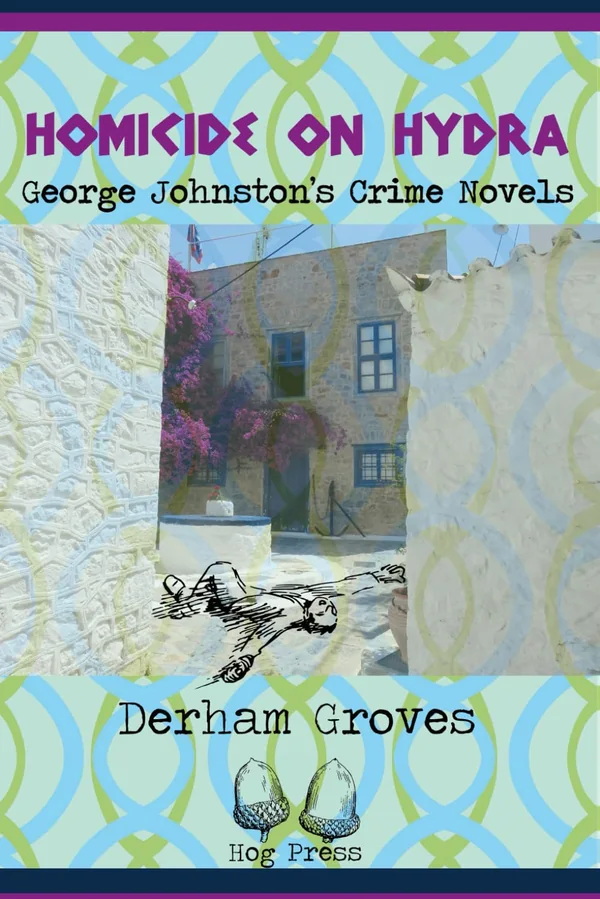
Homicide on Hydra

The cover of Homicide on Hydra: the title in purple Greek-style capitals over a photograph of a stone house on Hydra with bougainvillea and a whitewashed well, a drawn body lying on the paving, on a pattern of blue and green rings.

George Johnston’s Crime Novels

Derham Groves, with a preface by Des Cowley and Susan Millard and a foreword by Ian Morrison. Hog Press, 2023. ISBN 978-1-941892-70-1.

Paperback and hardcover (ISBN 978-1-941892-71-8), 304 pages.

The first study of the five Professor Challis novels: a chapter on each, with its plot told in full (the books are hard to find, so there are spoilers), how it was published, what the reviewers said, and the people, places and events of Johnston’s life that went into it.

Amazon, paperbackAmazon, hardcoverBooktopiaHog Press

“Imagine if Hemingway scholars chose to ignore five of the books he wrote, even though they were vehicles for trying out different things — some later used in his other books — and revealed his personal and professional contacts and views on all sorts of things from food and wine to homosexuality, all because he wrote them using a pseudonym and once suggested they were lurid tales written to make some desperately needed money. That would not be very scholarly, would it?”

Derham Groves, on the back cover

SourcesRead 10 October 2026

Where this comes from

His life is from the Australian Dictionary of Biography, from Nadia Wheatley, and from the newspapers of his time, read on the National Library’s Trove; the novels are from Derham Groves’s Homicide on Hydra, his article in Pursuit and the reviews of the day. Each row names its sources under it. The photographs are the State Library Victoria’s, the State Library of New South Wales’s, the Australian War Memorial’s, the newspapers’ and the National Archives of Norway’s, each credited where it is shown and linked to its record. Where the sources disagree, the page goes with the record made nearest the event, and the disagreement is here:

  • Where he was born: Caulfield, says the Australian Dictionary of Biography; Malvern, say Nadia Wheatley and his obituary. In 1915 the family lived at 28 Malakoff Street, which is in Caulfield but had a Malvern address.
  • When he became the first accredited war correspondent: 1941, says the Dictionary; The Argus reported the appointment on 10 February 1942.
  • How he and Clift left The Argus in 1946: he resigned, says the Dictionary; both were sacked, say others; she was sacked and he resigned in protest, say others again.
  • When he died: 22 July 1970, by the Dictionary and his probate; “Tuesday night”, the 21st, by his obituary in The Canberra Times.
  • How many crime novels: five, says everyone, though one sentence of the publisher’s blurb for Homicide on Hydra says seven.
  • Where he wrote A Wake for Mourning: Stanton, says Groves in Pursuit; Staunton, says Kate Jackson’s review of his book.
  • How long they lived on Hydra: nine years, or ten, or, counting Kalymnos, eleven.